Microsoft Fabric Implementation. Unified Analytics, Properly Architected.

Architected Fabric solutions that unify your data estate - lakehouses, pipelines, semantic models, and analytics - under one governed platform.

The Challenge

Microsoft Fabric promises a unified analytics platform, but most organizations don't know where to start. Without proper architecture, Fabric becomes another tool - not the transformative platform it's designed to be.

Legacy warehouses, disparate pipelines, ungoverned data, and unclear migration paths create risk. You need a partner who understands both the technology and the organizational change required.

Our Solution

Radiant Data Solutions architects and deploys Microsoft Fabric environments purpose-built for your data estate. We design lakehouses, build data pipelines, optimize semantic models, and implement governance - delivering a unified analytics platform that replaces fragmented tools with a single governed foundation.
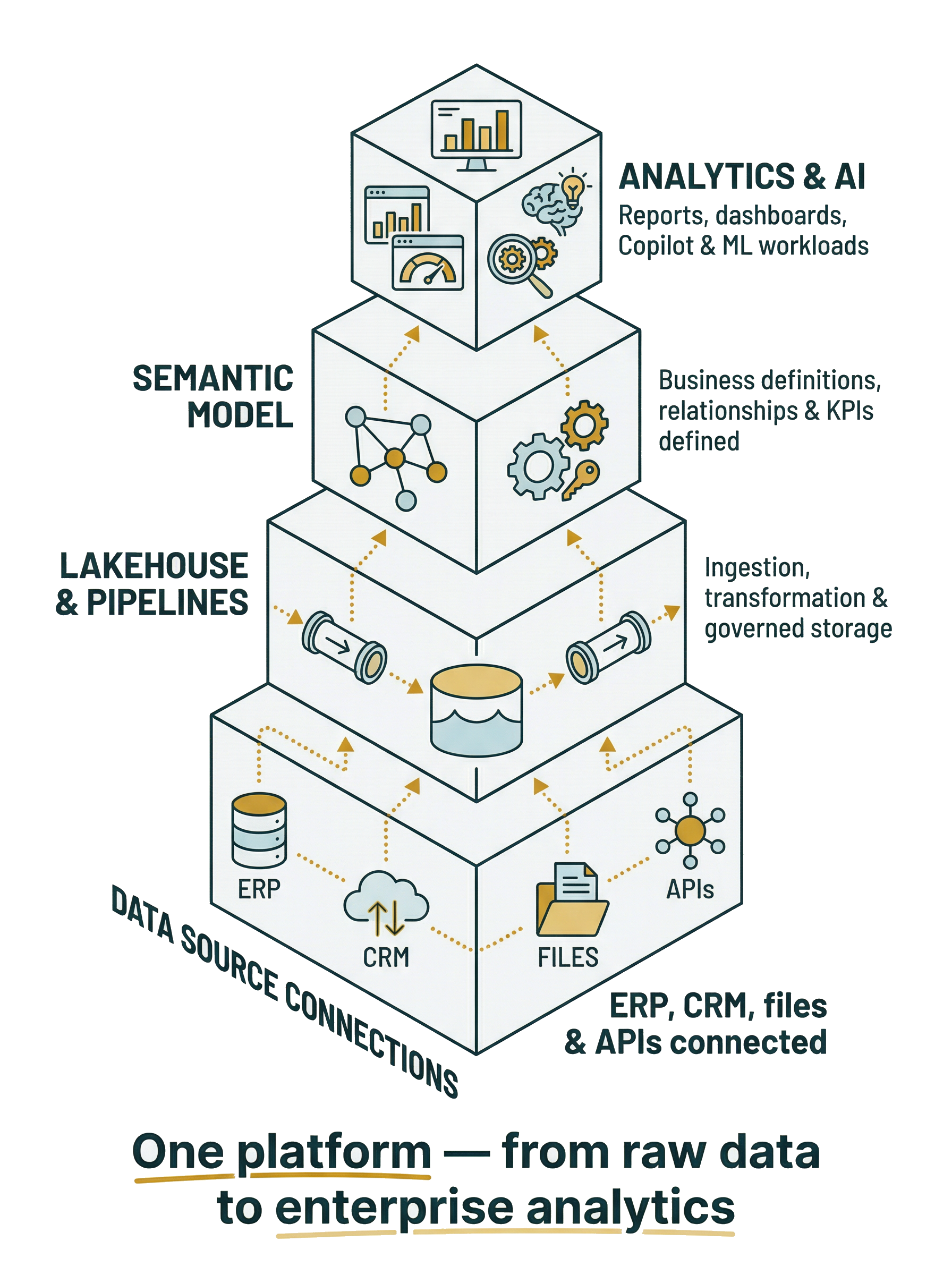
Microsoft Fabric Implementation Process

What We Deliver

We design, deploy, and govern Microsoft Fabric environments that serve as the foundation for enterprise analytics.

Architecture & Design

  • Lakehouse & warehouse design
  • Data pipeline architecture
  • Semantic model optimization
  • Migration planning & execution

Governance & Security

  • Workspace governance framework
  • Data quality standards
  • Access control & compliance
  • Monitoring & alerting

Scale & AI

  • Capacity planning & optimization
  • AI & Copilot readiness
  • Multi-source integration
  • Real-time analytics enablement

Sample Engagement: We migrated a 17-location enterprise from a restrictive legacy vendor to Microsoft Fabric, unifying 7 independent operational systems into a single governed semantic model. No more vendor lock-in, no more data silos, and reporting that survives system changes. Read the case study →

Frequently Asked Questions

What is Microsoft Fabric and how is it different from Azure Synapse?

Microsoft Fabric is a unified analytics platform that combines data integration, engineering, warehousing, science, real-time analytics, and business intelligence. It replaces the need to stitch together separate Azure services by providing a single, governed environment.

Do we need to migrate from our current data warehouse?

Not necessarily. We assess your current architecture and recommend the best approach - whether that's a full migration, a hybrid model, or extending your existing environment with Fabric capabilities like lakehouses and semantic models.

How long does a Fabric implementation take?

A focused proof-of-concept can be delivered in 4�6 weeks. A full enterprise implementation with multiple data sources, governance, and reporting typically takes 3�6 months depending on complexity.

Can Fabric work with our existing Power BI reports?

Yes. Fabric is built on the same Power BI service you already use. Existing reports continue to work, and semantic models in Fabric enhance them with better performance and governance.

Is Fabric ready for AI and Copilot?

Fabric is Microsoft's AI-ready analytics platform. With proper semantic models and governance in place, your organization can leverage Copilot for Power BI and other AI capabilities directly within the platform.

Ready to Unify Your Data in Fabric?

Fabric is powerful, but only if it is architected right. Let's talk about your data environment and what a Fabric foundation could look like for you.

Start a Conversation