Case Study
From Vendor Lock-In to Owned Infrastructure: How a 17-Location Enterprise Rebuilt Their Analytics Foundation
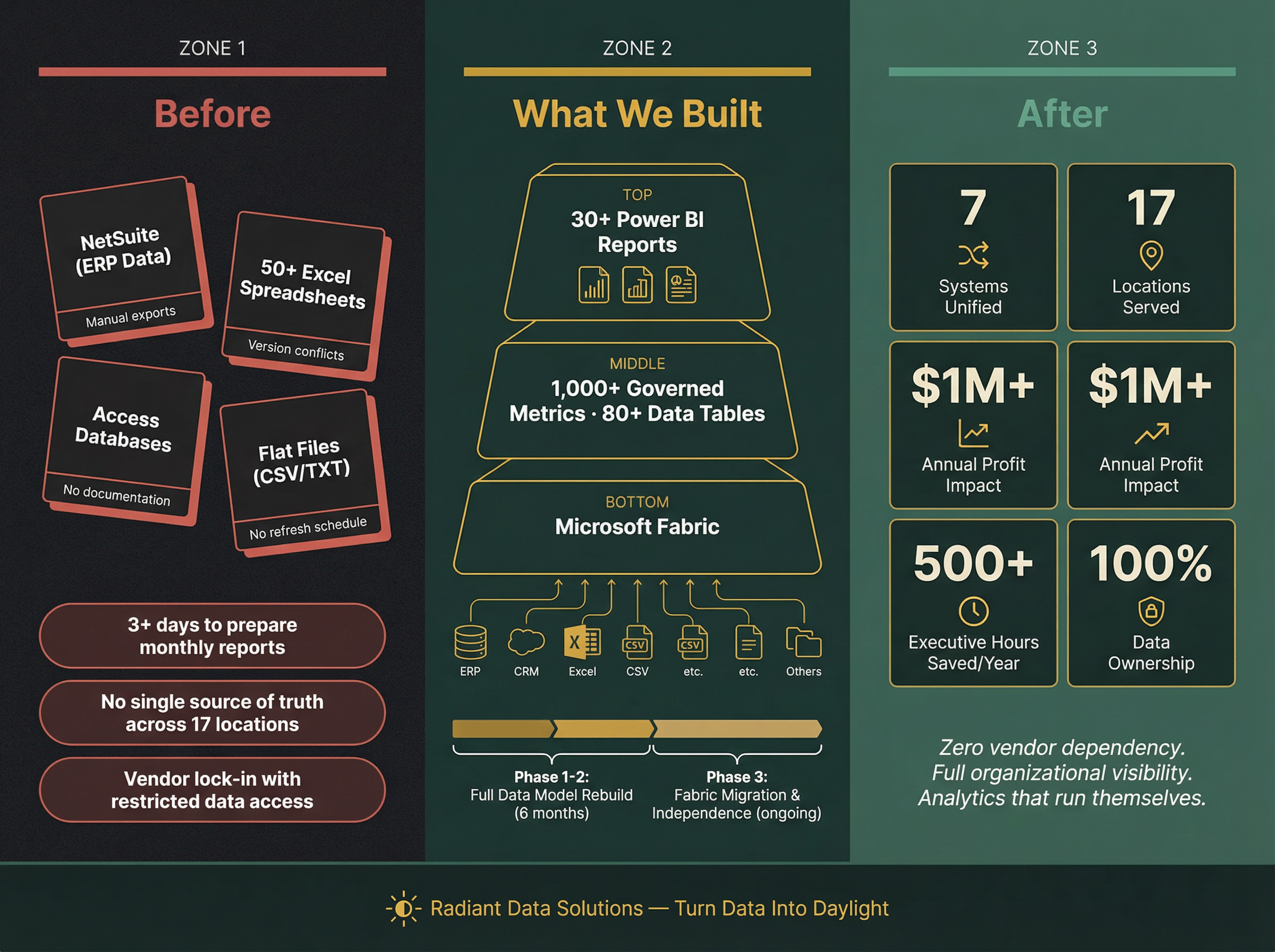
In July 2023, a multi-location enterprise (17 operating sites, 300 employees, ~$500M annual revenue) engaged us to improve the front-end reporting built on top of an existing third-party data warehouse. What began as a request for report redesign evolved into a full-scale analytics transformation.
What We Built
Enterprise platform delivered across three phases.
Phase 1 & 2: Full Data Model Rebuild
- 80+ structured data tables forming a single source of truth across all departments
- 1,000+ governed metrics ensuring every team reports the same numbers
- 30+ reports replacing manual processes that previously took days each month
- Role-Level Security (RLS) ensuring each audience sees only relevant data
- Centralized semantic model serving executives, operations, finance, and HR
Functional Coverage
- Executive reporting and strategic KPIs
- Financial & accounting oversight and planning
- HR analytics and workforce performance
- Inventory management and logistics tracking
- Sales performance and forecasting
- Productivity tracking across 17 locations
- Incentive compensation workflows with writeback
Phase 3: Fabric Deployment & Migration
- Platform migrated from legacy single-system dependency to Microsoft Fabric
- Seven independent operational systems integrated into one semantic model
- System-agnostic architecture built on business logic-not source-system logic
- Seamless replacement of operational systems without breaking reports
- Transactional analytics with approval and denial writeback workflows
Why System-Agnostic Design Matters
The model is built around business logic, not vendor logic. This means any upstream system can be replaced, added, or swapped without disrupting reports-giving the organization long-term resilience against technology changes and vendor constraints.
Organizations That Face This Challenge
- Multi-location enterprises dependent on a single legacy CRM or ERP system
- Organizations scaling past what their current reporting infrastructure can handle
- Companies whose analytics vendor restricts access or limits customization
- Leadership teams making decisions from siloed, inconsistent reports
- Businesses preparing to migrate operational systems without losing reporting continuity
See How We Engage
Production-Ready Outcomes
From Vendor-Constrained Reporting to Owned Infrastructure
What began as a report facelift evolved into a fully owned, governed analytics platform.
Performance & Scale
- Eliminated all model latency and performance degradation
- 30+ governed reports serving every business unit
- Enterprise-ready architecture that scales with organizational growth
Operational Capability
- Analytics extended from passive reporting to operational execution
- Writeback workflows enabling real-time incentive tracking and approvals
- Managers and employees interact directly within the reporting environment
Strategic Resilience
- System-agnostic architecture absorbs future technology changes
- Seven upstream systems integrated without architectural disruption
- No single-vendor dependency risk-the organization owns the model
1,000+
Custom DAX Measures