Service
Enterprise Data Warehouse Design - Architecture Built for Scale and Performance
Many organizations struggle with legacy data infrastructure that doesn't support modern analytics. Disparate systems, manual ETL processes, inconsistent data quality, and governance gaps create a fragmented analytics landscape. You need to consolidate data, establish standards, and build architecture that supports future growth and AI workloads.
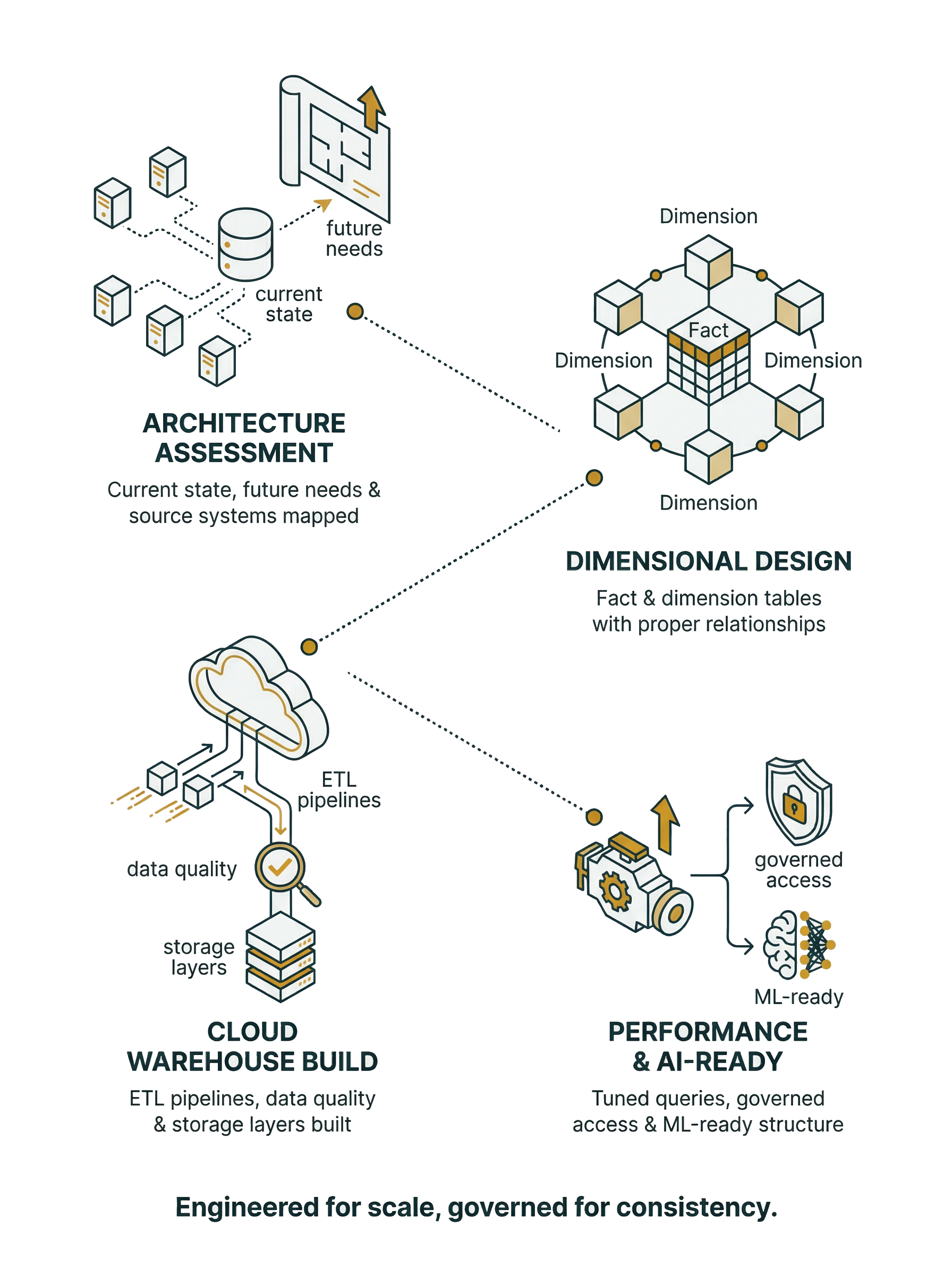
What Enterprise Data Warehouse Design Includes
Our data warehouse consulting covers comprehensive architecture transformation.
Architecture & Design
- Architecture assessment and future-state planning
- Data modeling and dimensional design
- Cloud platform selection and implementation guidance
Implementation
- ETL/ELT pipeline architecture
- Performance optimization and indexing strategies
Governance
- Data quality frameworks and governance
- Ongoing support and optimization
Sample Business Use Cases
We design platforms built to evolve, not just solve today's challenges. Enterprise data teams consolidate disparate source systems into unified dimensional models that eliminate data silos. Analytics directors implement governance frameworks that ensure consistent business definitions across all reports and dashboards. IT leaders migrate legacy on-premise warehouses to cloud platforms with optimized performance and reduced costs while supporting AI workloads.
See How We Engage
Business Impact of Enterprise Data Warehouse
Governed, Scalable Data Foundation
Organizations implementing a modern enterprise data warehouse gain faster, more reliable access to data; consistent, governed analytics across the business; and the foundation to support advanced analytics and AI.
Reporting from days to minutes
The result: faster decision-making, better data governance, and competitive advantage through data infrastructure.